1
Ask a question
Enter an optional yes-or-no question so the result has context.

Decision Dice
Roll a six-sided decision die: three green faces mean Yes and three red faces mean No.
Faces 1–3 = No · Faces 4–6 = Yes
Ready
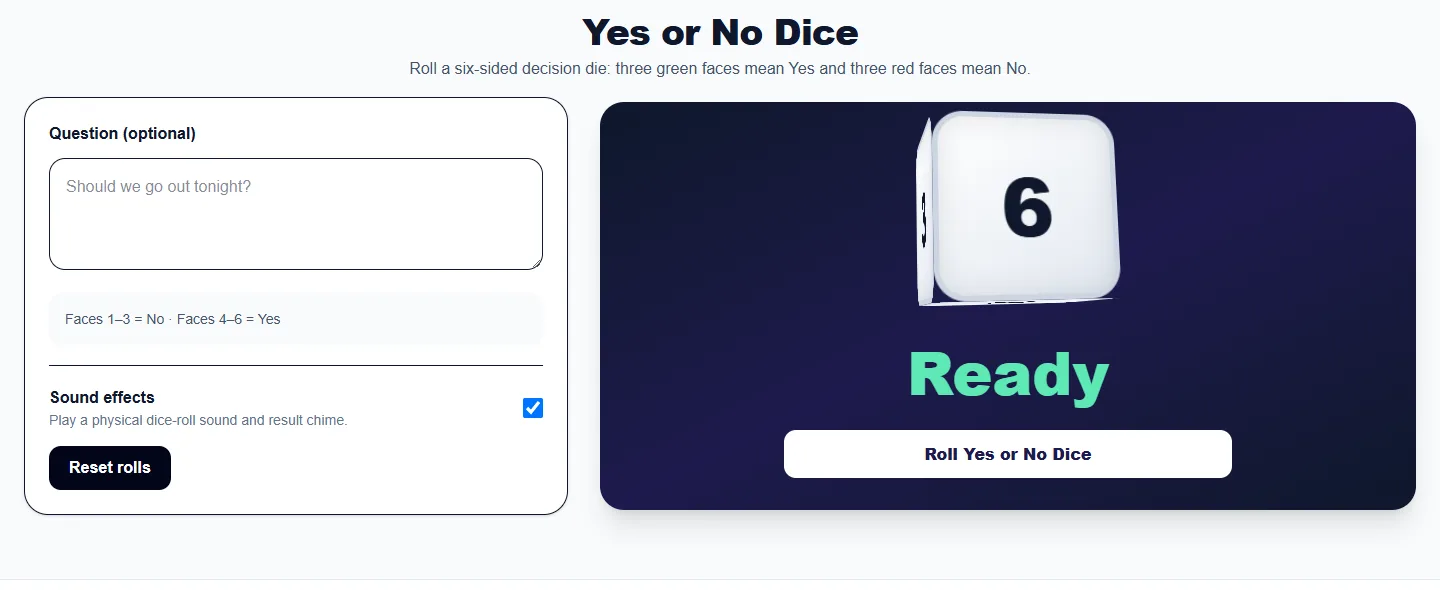
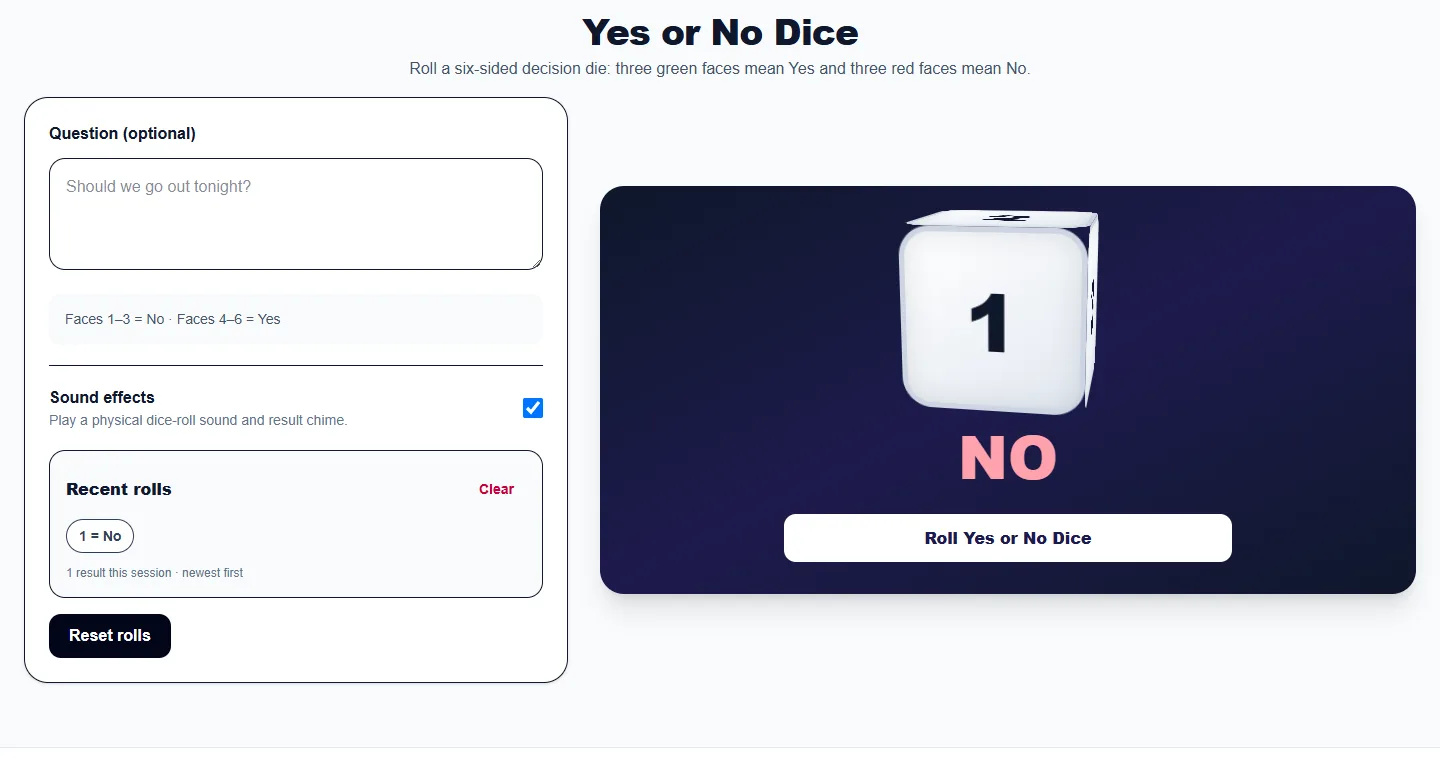
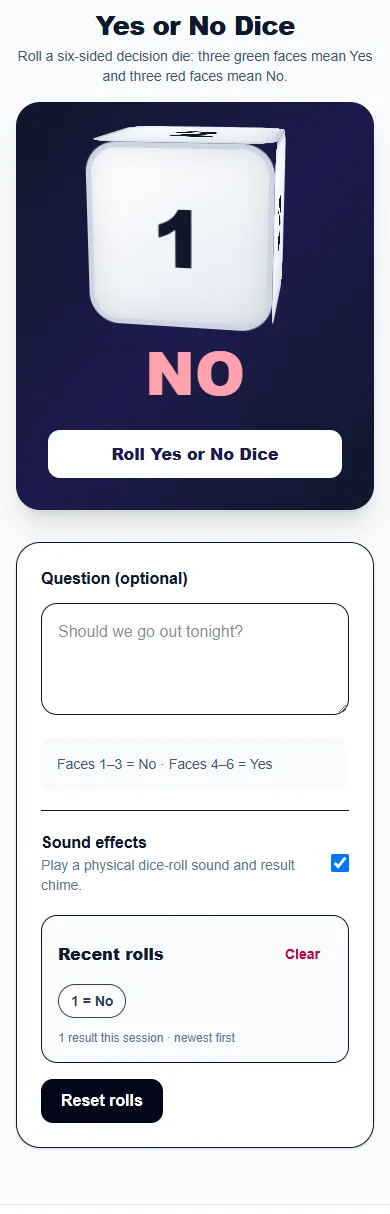
These captures show the current English controls on desktop and phone. Follow the steps below each image; your random results will vary. Select an image to view it at full size.
About this tool
A Yes or No Dice maps three faces to Yes and three faces to No. That produces the same 50/50 odds as a coin flip while keeping the familiar feel of rolling a six-sided die.
The numeric face and its mapped answer stay visible after each roll, and the session history records recent results until you reset it.
Enter an optional yes-or-no question so the result has context.
Faces 1–3 produce No and faces 4–6 produce Yes.
See recent rolls, roll again, or clear the session.
These examples show how the tool can turn a common question or list into a clear random result.
Roll once: a 1, 2, or 3 means No, while a 4, 5, or 6 means Yes.
Compare several rolls with the expected 50/50 split and discuss why a short session may not be perfectly even.
Use the animated decision die when a physical six-sided die is unavailable.
Use a die-style answer when it fits the game better than a wheel.
Demonstrate how six equally likely faces can represent two equal outcomes.
Resolve a low-stakes decision with a quick animated roll.
Faces 4, 5, and 6 mean Yes. Faces 1, 2, and 3 mean No.
Yes. Each answer is assigned to three of the six equally likely faces.
Yes. Use the sound toggle before rolling.
More from Spinning My Wheel
Jump to another main picker when you need names, decisions, party prompts, or random numbers.
Add names or choices, spin the wheel, and pick one at random.
Open tool →Get a random yes, no, maybe, or decision-style answer.
Open tool →Spin for Truth or Dare with built-in categories and prompts.
Open tool →Choose a number range or open one of our focused random generators.
Open tool →